
Sakaja cites Urban Areas Act as Senate probes Nairobi–National Govt pact

Audio By Vocalize
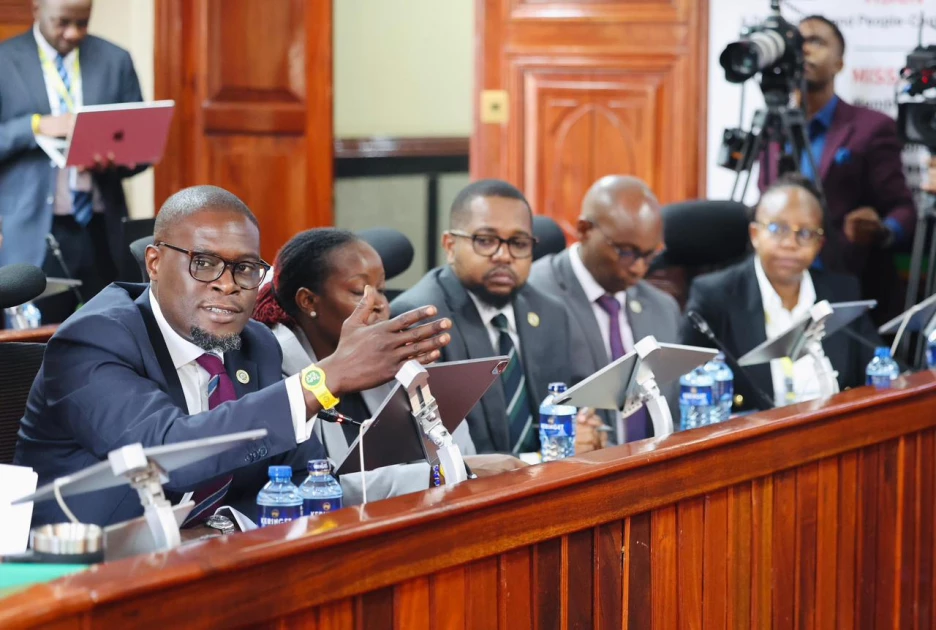
Sakaja told the committee that the agreement is neither unusual nor illegal, but rather a long-overdue framework grounded in law and aligned with global best practice.
“First, what we are having as an agreement is not new internationally. Every first-world city has such an arrangement. This cooperation is long overdue. I have spoken about it even when I was the Senator of Nairobi. We need more money. Nairobi is different apart from being a county, it is the face of Kenya as the capital city,” he explained.
The Governor cited Section 6 of the Urban Areas and Cities Act, noting that it provides for cooperation between the two levels of government.
“It is mandatory, as provided for in law, to cooperate. It is indeed late, coming 13 years since devolution,” he added.
Sakaja argued that Nairobi’s current allocation is insufficient to match the demands of a fast-growing capital.
“The allocation of the City of Nairobi as a county is hardly enough to put the city at an international level. Paris has a budget of Sh1.5 trillion with two million people. Nairobi, with seven million people, has only about Sh45 billion. To be where Paris is, we need more money,” he said.
He emphasized that the cooperation agreement does not amount to a transfer of functions under Article 187 of the Constitution, which would require a formal deed of transfer and could create a separate institution such as the Nairobi Metropolitan Services (NMS).
“This is not a transfer of functions. We shall continue running as a county, and the National Government will come in to provide additional resources for development,” he clarified.
The Governor pointed to ongoing and planned projects as evidence of the benefits of collaboration. He revealed that the National Government has already provided Sh1 billion for the construction of additional classrooms in Nairobi, some of which were handed over this week.
“As a Governor, why should we struggle with this budget when the law provides for cooperation? We embraced it,” Sakaja said.
He singled out the Nairobi River rehabilitation programme, a Sh50 billion project aimed at restoring the river and upgrading sewer lines expected to serve the city for the next 40 years.
“That will change Nairobi. Where can we get Sh50 billion as a county?” he posed.
On street lighting, Sakaja noted that security is primarily a national government function, and enhanced collaboration would address long-standing concerns.
“Lighting is a security issue of the National Government. This collaboration will sort that,” he said.
The Governor also addressed concerns about public participation, clarifying why it did not take place prior to the signing of the cooperation agreement.
He told senators that the Constitution must be read “holistically and conjunctively,” pointing to Article 118 on public participation alongside Article 6(2), which compels the two levels of government to conduct their mutual relations on the basis of consultation and cooperation.
“The Constitution uses mandatory language 'shall cooperate’ under Section 6 of the Urban Areas and Cities Act. That directive already reflects the sovereign will of the people as captured in the Constitution. When the people have already spoken clearly through the Constitution, does every cooperation framework require fresh validation?” he posed.
He maintained that the framework under which President William Ruto and Nairobi City County entered into the agreement is constitutionally anchored.
“The people of Kenya, who authored the Constitution, expressly provided that there shall be cooperation between the two levels of government. This is not a handover; it is cooperation,” he said.
While acknowledging that public participation remains a constitutional value, Sakaja argued that the legal basis for intergovernmental collaboration is already firmly established in law.
Senators further pressed him on how the Sh80 billion package would be accounted for, given the involvement of both levels of government.
“Oversight is a constitutional mandate of Parliament. Funds under national government structures are overseen by the National Assembly. Matters touching on devolution fall within the mandate of the Senate. So if any monies are lost, there is a clear way to address that,” he clarified.
Under Kenya’s governance framework, the National Assembly scrutinizes national expenditure, while the Senate safeguards devolved interests and oversees county-related functions. Statutory audit institutions also remain in place to examine how public funds are utilized.
Meanwhile, the Nairobi City County Assembly has begun public participation forums on the Cooperation Agreement. The Ad Hoc Committee is conducting hearings at Charter Hall, City Hall, and across all 17 sub-counties, as debate continues over the future governance and financing of the capital.
The Senate committee is expected to review the agreement and table its recommendations as scrutiny of the landmark Nairobi–State partnership continues.
Join the Discussion
Share your perspective with the Citizen Digital community.
No comments yet
This discussion is waiting for your voice. Be the first to share your thoughts!