
Ruto: AI-enabled cameras, surveillance systems deployed to protect Rhino Sanctuary

Audio By Vocalize
Speaking during its commission in Ngulia, Taita Taveta County, President Ruto said that Kenya shoulders the weight of global heritage responsibility to safeguard the endangered black rhino, noting that the country host nearly 78 per cent of the world’s remaining Eastern Black Rhino population.
“We have in our custody nearly 78% of the global population of Eastern Black Rhino; this is not simply our conservation achievement; it is a sovereign responsibility of global significance,” Ruto said.
To secure the sanctuary, Ruto says the government has deployed advanced AI-enabled surveillance cameras, drones and an aerial monitoring system, long-range network connectivity, encrypted digital radio networks, patrol vehicles, and over 300 security personnel. A fixed-wing aircraft has also been assigned to rapid response to threats within the sanctuary.
“We have built more than 250 km of upgraded fencing, 40 new ranger houses and operational bases, open access road, catlines and firebreak and expanded water infrastructure across the landscape,” the Head of State added.
He stated that more than $4.7 million (approximately Ksh. 607 million) has already been invested through the Kenya Rhino Range Expansion initiative to strengthen Tsavo’s protection capacity, making it one of the most advanced wildlife security operations on the continent.
The Head of State noted that the expansion, now covering more than 3,200 square kilometres, was essential to addressing congestion that has threatened the species for years. Over 80 per cent of Kenya’s Black Rhinos have been living in overcrowded sanctuaries, reducing breeding potential and increasing the risks of territorial conflict.
According to Ruto, Kenya’s rhino population had once dropped to fewer than 20 in 1989 due to poaching, drought and land pressure. He says the decline prompted the establishment of the Kenya Wildlife Service (KWS) to prevent such losses from recurring.
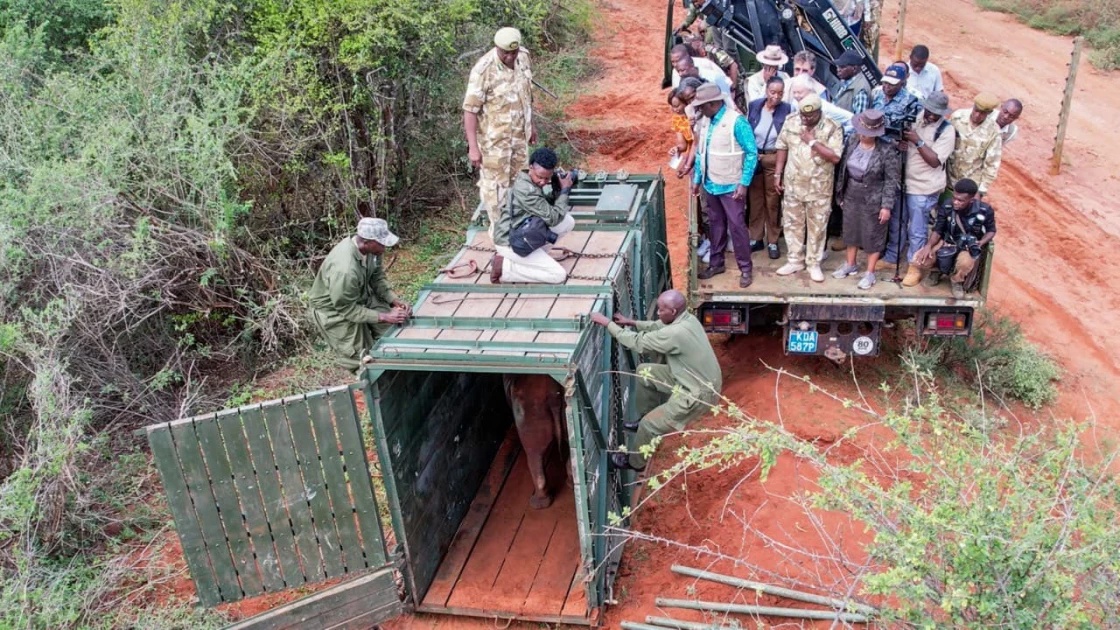
Before the expansion, the government conducted what the President described as the largest Rhino monitoring and tagging exercise ever recorded anywhere in the world. 90 Rhinos were safely immobilised, while 89 were fitted with digital identifiers and modern tracking devices, enabling real-time monitoring of their movement, health and security across the vast landscape.
Ruto also said that the improved space and security, reduced density and enhanced genetics now position Kenya to raise the national black rhino population growth rate from 5 per cent to 8 per cent annually.
“This will directly advance our national target of 1,450 Rhinos by 2030 and 2,000 Rhinos by 2037. Today, Kenya is home to about 2,100 Rhinos, including 1,060 Black Rhinos and 1,040 Southern White rhinos and the world's last 2 Northern White rhinos,” he said.
The President added that the expanded sanctuary will not only protect wildlife but also support local communities. The project is already creating jobs in ranger deployment, surveillance, construction, logistics, and road works. By 2030, it is projected to create more than 18,000 jobs and generate over $45 million (approximately Ksh. 6 billion) in conservancy and tourism revenue.
“We are redefining conservation in Kenya, not as a cost to taxpayers but as a national investment class. We will ensure that the community are not a spectator in this journey but stakeholders in Kenya's green future.”
Join the Discussion
Share your perspective with the Citizen Digital community.
No comments yet
This discussion is waiting for your voice. Be the first to share your thoughts!