
OPINION: The youth position in championing education for disadvantaged groups
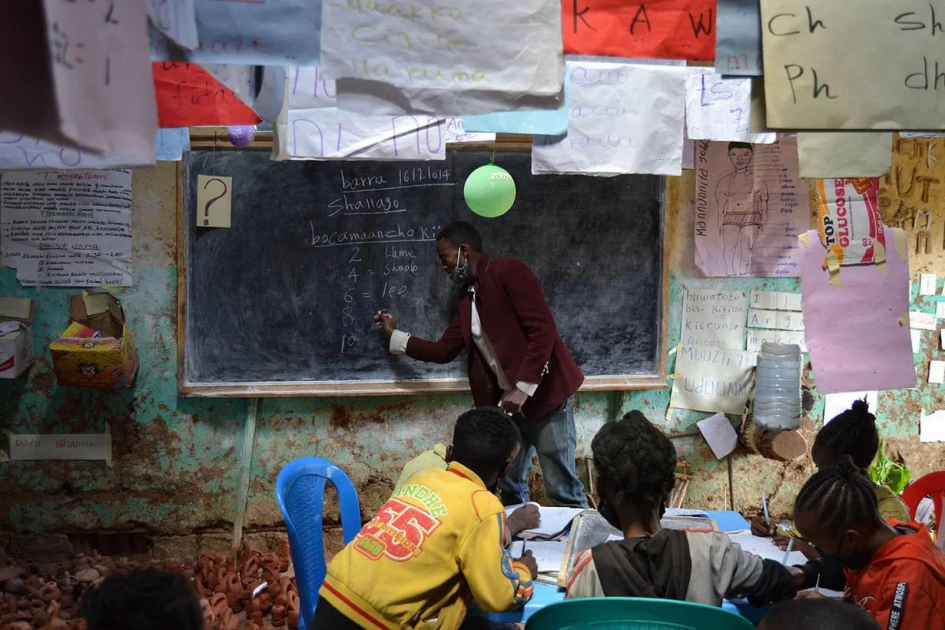
A facilitator teaches numbers to pupils in a second chance classroom in Sidama Region, Ethiopia. October 26, 2021. Thomson Reuters Foundation/Emeline Wuilbercq

Audio By Vocalize
Young people should raise awareness on the importance of education for disadvantaged groups. However, we must approach this issue with caution to ensure that we don’t sacrifice our education on the altar of advocacy.
One of the reasons Youth should support advocacy is from the power of education to lift disadvantaged individuals out of the cycle of poverty, and create a better future for them and their communities.
Tim Wigmore, in The New Statesman reports on how the principal at The Malling School in Kent, “Roberts, says that, all too often, these pupils ‘will be worried about their parents, they will be worried about where their next meal is coming from. And suddenly they are no longer worried about passing exams’.”
As uneducated parents pass down their hardships to their children, these vulnerable populations experience poverty and hunger, and it becomes an ongoing cycle.
To allow this to continue to happen is to keep entire families trapped in cycles of poverty.
In the Marvel universe, a super power is an unnatural ability granted by the gods or some sort of magical force which often allows an individual to fulfil their fate and overcome great challenges.
However, in the real world, education is an super power, perhaps greater than Spiderman’s web-slinging or Superman’s heat vision, due to its potential to lift disadvantaged individuals out of poverty and create a better future for them and their communities.
Beyond lifting one from the cycle of poverty, education has the ability to reduce the rising cases of girls getting married as teenagers.
As Michelle Obama, the former US First Lady and an absolute icon, put it: “parents just can’t afford to educate their daughters” adding that, “Instead, girls are often kept home to do household labor; many get married when they’re just barely teenagers and start having children of their own.”
No girl should have to trade textbooks for marriage vows just because education comes with a price tag! Most of the girls who are forced to marry at such a young age are often pressured by the harmful cultural attitudes that marginalized communities around the world seem to have.
Isn’t it just heartbreaking to imagine other 16 year olds out there nursing infants and feeding their entire families instead of socializing with friends at school and learning important lessons?
However, with education, these girls have an opportunity to take a different path in life, one where they can delay marriage, gain independence, and build a future on their own terms.
Perhaps the most compelling reason to take part in programmes that raise awareness about the importance of education for disadvantaged groups is our moral duty, especially since many of those affected are young people.
Michelle Obama highlights a devastating reality when she says, “girls are sometimes even sexually harassed or assaulted,” and “they’re more likely to contract HIV.”
These aren’t just statistics, they’re real, everyday issues that could easily be happening to a friend, a sister, or any girl we know.
What’s more, Tim Wigmore paints a similar picture for boys from disadvantaged backgrounds, revealing that “a white working-class boy is less than half as likely to get five good GCSEs” and that, “in the job market, poor white boys are left standing at the back of the queue.”
This hits home, doesn’t it? I mean, we all have boys in our lives that we care for dearly, be it your own brother, cousin, friend, or boyfriend, and we wouldn’t want to see them jobless in the future, would we?
By participating in these programmes, we give these young boys and girls the chance to rewrite their futures, alongside us as we write our own.
Participating in advocacy for education is not a burden, it is a chance to make a lasting impact.
To address negative thoughts regarding the disruption of our own academic focus and supposed burnouts caused by overcommitment, students can individually set clear boundaries and prioritize tasks.
I would hope that we all have the cognitive capacities to create our own schedules. Most of us already follow study time tables, don’t we? Well then, it shouldn’t be too hard to allot specific time slots each week for advocacy work.
Moreover, while it’s true that advocacy could potentially take away your focus from your own studies, let’s be very real with each other, the only people who’ll be moaning about ‘losing focus’ are those who already spend more time scrolling through TikTok than opening a textbook. If you’re serious about your studies, balancing both won’t be a problem.
Advocacy for education for disadvantaged groups is a chance to ensure that all young people, regardless of their background, have the future they deserve.
This despite concerns that it might distract us from our own studies. It is not the advocacy, but those who fail to balance it with their responsibilities, that should be worried. The truth is, those who are committed to both will find a way to make it work.
Join the Discussion
Share your perspective with the Citizen Digital community.
No comments yet
This discussion is waiting for your voice. Be the first to share your thoughts!