
OPINION: Nairobi's AI Moment: From Dialogue to Delivery
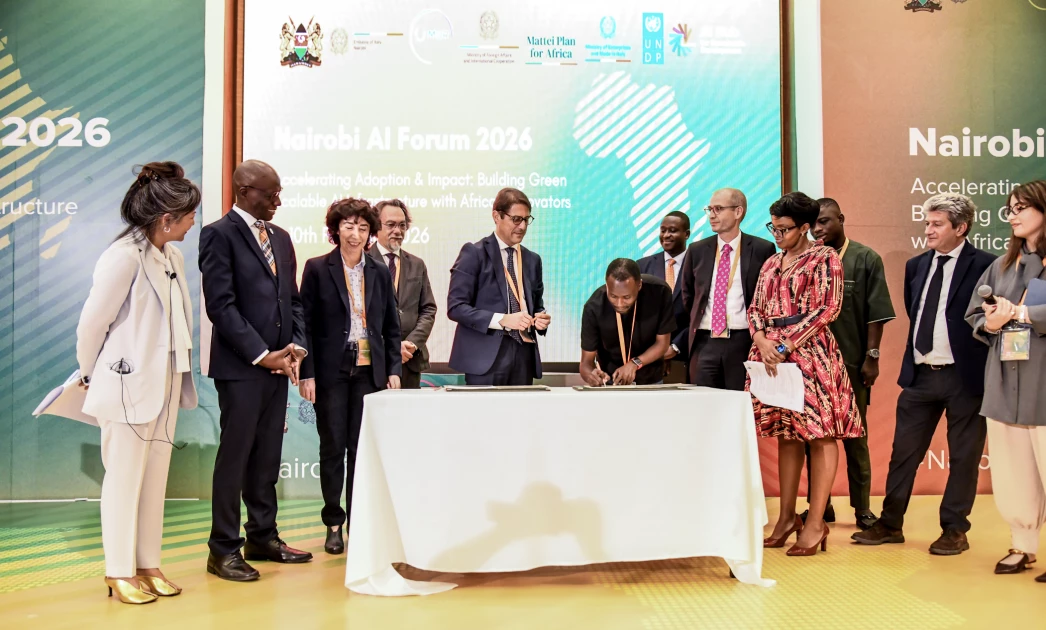
Delegates during the Nairobi AI Forum. The forum convened more than 500 participants from Africa, Europe, and the G7; it was designed to translate AI from a global abstraction into a local opportunity through renewed partnerships and aligned ambitions.

Audio By Vocalize
The Nairobi AI Forum, held on February 10, 2026, signalled a strategic shift in how Africa and its partners intend to engage with artificial intelligence in the decade ahead.
Not as spectators. Not as recipients of imported solutions. But as co-creators of capabilities, we are shaping the institutions, infrastructure, and partnerships that will define the Intelligence Economy.
For too long, Africa's technology narrative has been framed as a story of "catching up", a continent perpetually on the receiving end of innovation, investment, and decision-making.
The Nairobi Forum was a deliberate interruption of that narrative. Convening more than 500 participants from Africa, Europe, and the G7, it was designed to translate AI from a global abstraction into a local opportunity through renewed partnerships and aligned ambitions.
Generative diplomacy: building, not performing
In the Age of Intelligence, partnerships built on courtesy calls and broad declarations are no longer sufficient.
The African continent, with its impatient young population, needs delivery partnerships structured cooperation spanning compute access, talent mobility, research collaboration, and investment pathways.
The partnership between Italy and Kenya, led by Prime Minister Meloni and President Ruto under the Mattei Plan for Africa, is entering a new era of concrete intelligence cooperation, shifting from dialogue to delivery.
This is generative diplomacy: more inclined to create processes than to occupy spaces and screens.
At the Nairobi Forum, no chandeliers were sparkling like constellations above people's heads. Instead, there were hundreds of young entrepreneurs, connected to the other one million people following remotely, each with their own needs, expectations and projects.
Kenya and Italy, working with UNDP through the AI Hub for Sustainable Development, are entering a defining phase of partnership evolving beyond traditional aid toward the co-creation of future economic capability.
While the industrial era was shaped by energy and manufacturing, and the digital era by connectivity and software, the Intelligence Economy will be defined by compute infrastructure, sovereign talent, shared innovation in models and applications, and the ability to translate research into industrial production. What each of these eras has in common is vision and courage.
This matters because the global order is being reshaped by AI. Countries and regions that lock in the right partnerships now—rooted in mutual value and shared capabilities will define the next wave of prosperity. Those who do not will simply import someone else's future.
As President William Ruto continues to emphasise, "no country can develop beyond its knowledge capacity."
Opportunity is designed, not delivered
AI is often discussed as if it is an inevitable force that will "arrive" in Africa. But opportunity is not given by default—it is a system that is designed and fought for.
If Africa is to benefit, we must address the structural question: who has access to compute, data, capital, markets, and the right governance environment to build?
The Nairobi Forum responded with concrete action. The allocation of 1.5 million GPU hours to 130 African innovators, in partnership with Cineca, along with credits from AWS and Microsoft, bridges the gap between imagination and execution.
When African builders can train, test, and deploy models especially for climate resilience, local-language applications, and food security, Africa's AI story shifts from consumption to production.
Senator Anna Maria Bernini, Italy's Minister of University and Research, said: "Strengthening skills, training and research is the strategic choice to support innovation, technological sovereignty and inclusive progress in Africa and with Africa."
Co-creation in practice
The Forum's significance lies in what comes next. The co-designed launch of an AI 10 Billion Initiative—in collaboration with the African Development Bank, UNDP, and partners—targets generating up to 45 million jobs across Africa by 2035.
Practical partnerships demonstrate the shift from aid to co-creation. UNDP's work creating 400 jobs in partnership with the private sector for people with disabilities shows what AI-enabled partnerships can deliver at scale.
The space-enabled AI collaboration for food security, led by Kenya's Ministry of Agriculture and the Kenyan Space Agency, with support from the Italian Space Agency, "Luigi Broglio" Space Base in Malindi, FAO, NASA Harvest, and Microsoft, builds the data foundations that benefit farmers, insurers, and public agencies.
Co-creation means Africa doesn't only supply "use cases"—it sets the agenda. Africa doesn't only contribute "data", it builds governance institutions.
Africa doesn't only receive "training", it develops sovereign talent ecosystems. Africa doesn't only offer a market, it has access to capital and other markets, with Italy serving as a potential gateway through non-extractive cross-pollination between ecosystems.
The window is still open
The world is racing to define AI standards, markets, and governance approaches. If Africa waits, it will inherit other people's rules and rent other people's infrastructure. If Africa builds now, it can shape norms, build industries, and position its talent at the frontier.
The Nairobi Forum was not a declaration that Africa has arrived. It was something more consequential: a demonstration that Africa is organising to build.
Held ahead of the Italy-Africa Summit in Ethiopia and the AI Impact Summit in India, it brought together government, industry, academia, and finance around a shared logic: the continent's advantage will come from constructing the enabling environment that makes wins repeatable at scale, across sectors, and across borders.
That narrative is not about pride; it is about power—understood as the ability to co-design and fairly distribute opportunity.
The Nairobi Forum mattered because it was a turning point in how Africa frames its role: not as a market for someone else's intelligence but as a continent shaping the intelligence economy through partnerships rooted in democracy, ethics, co-creation, capability, and shared value.
H.E. Ambassador Philip Thigo, MBS (Special Envoy on Technology, Republic of Kenya), H.E. Ambassador Vincenzo Del Monaco (Ambassador of Italy to Kenya and Permanent Representative to UNEP & UN-HABITAT), and Keyzom Ngodup Massally (Director, AI Hub for Sustainable Development, UNDP)
Join the Discussion
Share your perspective with the Citizen Digital community.
No comments yet
This discussion is waiting for your voice. Be the first to share your thoughts!