

OPINION: Kenyans want better security outcomes and not fancy equipment
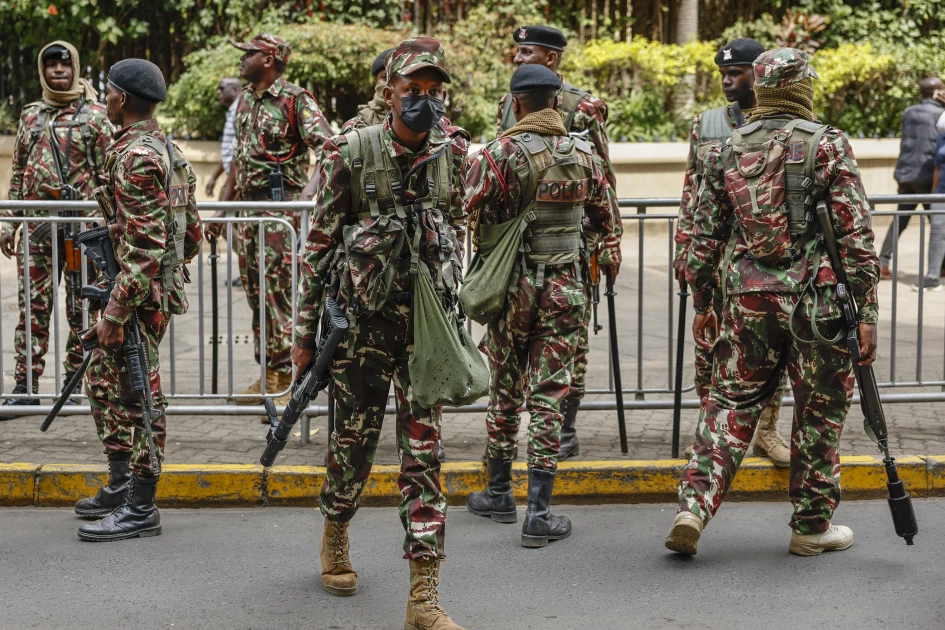
Kenya police officers gather while looking at protesters during a demonstration against tax hikes as Members of the Parliament debate the Finance Bill 2024 in downtown Nairobi, on June 18, 2024. Kenyan police fired tear gas and arrested dozens of demonstrators on June 18, 2024 as hundreds of people gathered near the Parliament building to protest tax hikes. (Photo by SIMON MAINA / AFP)

Audio By Vocalize
By Leonard Wanyama
Jitters over budget balancing have seen security sector chieftains speak up more on the kind of resources needed to protect lives and liberties of Kenyans.
Many citizens will be quick to point out that they’re more interested in a conversation on better security outcomes as opposed to more effective equipment.
As witnessed from the sentiments of Director General Noordin Haji of the
National Intelligence Service (NIS) while appearing before the Departmental Committee on Defence, Intelligence and Foreign Relations, Kenya needs better
tools to deal with numerous threats all round its borders.
Meanwhile, Ministry of Defence officials previously perplexed or
mesmerised the public with the acquisition of a sophisticated, advanced Israeli
Spyder missile defence system as part of its modernisation.
This showcased a gulf in understanding between officials and citizens on
what really constitutes threats Kenya faces, especially in the context of their
understanding of massive fiscal challenges, countrywide inequality and low
economic productivity.
However, this speaks to a glaring evolution of what contemporary
security means for citizens and what the institutional establishment needs to
consider as an opportunity to evolve if they are to serve Kenyans not only
diligently but satisfactorily.
Kenya’s overall stability in relation to its territorial sovereignty, as
projected by the integrity of its borders plus its internal security, popularly
referred to as governance, law, and order sector needs to go beyond the
national security agenda preoccupation.
This may require a greater consideration for public safety that infuses
a civil protection agenda to complement the existing national security agenda.
In as much as the citizenry appreciates the hard power needed to keep them
safe, the disappointments arise from chronic unresponsiveness to cyclical
emergencies for which they require consistent government intervention.
If the security establishment can match the requested equipment to
public safety needs and outcomes, then it would be much easier to justify such
expenditure. Kenyans foremostly desire fair warning and evacuation in good time
during floods or landslides but none ever comes to their aid reliably.
Despite annual drought or famine, there has never seemed to be a clear
discussion on properly managed shelters in the face of normalising the
phenomenon of internally displaced camps and such like approaches over many
years to the level of now becoming habitual.
Last year’s floods pointed to a need for more robust blackout
responsiveness plus both urban and rural rescue measures with seamlessly
coordinated medical services, voluntary assistance, and firefighting, if need
be, as was the desperate need during a gas explosion in Embakasi, but this
week’s floods point to no lessons learned.
Not much is known in relation to stockpiling of provisions in readiness
for the next emergency and the culture of corruption tends to dismally handle
supplies. Even in the media there’s never ever any serious coverage on whether
repair and recovery of indispensable public utilities or homes has taken place.
How about handling of the deceased plus need for DNA collection to
ascertain genealogy and facts; or should the country wait for another murderous
disaster like Shakahola to see the urgency of technology?
What if heritage sites are destroyed or objects of great national value
and significant relics are in danger? Does Kenya have the wherewithal to ensure
their preservation for survival?
There are many complementary activities that need to be carried out to
achieve the public safety measures mentioned but it requires that an emergency
is not only seen from the lenses of security restoration and maintenance of
order during distress alone.
Military and security equipment that best serves multipurpose or dual
functions will help Kenyans appreciate the hard power capacity even more when
it solves the common service delivery concerns of everyday life at the local
level.
The author is chief executive of the International Relations Society of
Kenya (IRSK) and Regional Coordinator of the East African Tax and Governance
Network (EATGN). Follow: @lennwanyama
Leave a Comment