
Kenya leads global breakthrough for sustainable Artificial Intelligence at UNEA 7
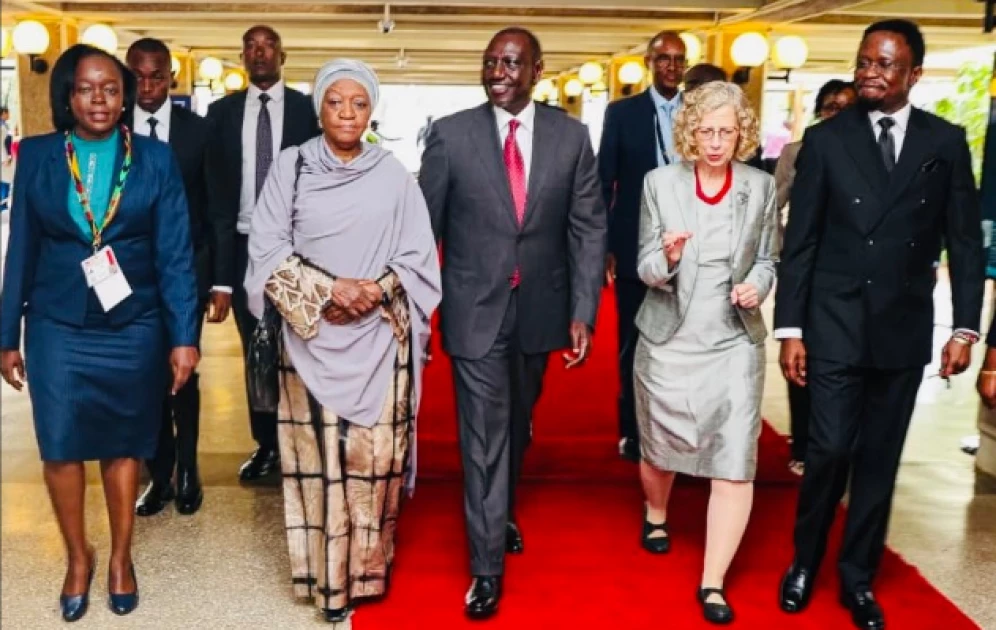
President William Samoei Ruto at the United Nations Complex, Gigiri for the official opening of the high level segment of the seventh session of the UN Environment Assembly (UNEA7), alongside Environment CS Deborah Barasa, PS Festus Ngeno, UNON DG Zainab Hawa Bangura and UNEP ED Inger Andersen and Kenya's Permanent Representative of the to UNON & UNEP Ababu Namwamba. PHOTO| COURTESY

Audio By Vocalize
Kenya has emerged as a global trailblazer after successfully
championing the first-ever United Nations resolution on the environmental
sustainability of artificial intelligence (AI) at the seventh session of the UN
Environment Assembly (UNEA-7).
This landmark decision not only elevates Kenya’s standing in
global environmental and technological diplomacy but also signals a decisive
shift, where Africa’s voice is shaping how rapidly evolving technologies
intersect with the planet’s future.
For the first time in UN history, a resolution has
comprehensively examined the environmental dimensions of AI. It addresses the
rapidly growing ecological footprint of AI systems, including energy and water
consumption, mineral extraction, and land pressure. At the same time, it
underscores AI’s transformative potential in supporting climate resilience,
biodiversity protection, and environmental monitoring.
AI is reshaping societies and economies worldwide, including
Kenya’s. Yet its explosive growth carries hidden environmental costs. Data
centres demand enormous water and electricity resources, while global
competition for critical minerals continues to intensify. Like many African
nations, Kenya faces these risks but has long lacked a platform to shape global
norms on sustainable AI governance.
By championing this historic resolution, Kenyan leaders
ensured that Africa is no longer a passive participant but an active
contributor in defining how AI affects people and the planet. The continent
faces acute climate vulnerabilities, limited data centre infrastructure, and
major gaps in environmental data—factors that make sustainable AI deployment
both urgent and essential.
The resolution affirms that AI systems must be
environmentally responsible, that AI should reinforce environmental protection
and climate action, and that developing countries must have equitable access to
high-quality, interoperable environmental data. It further calls for global
support to help nations build sovereign AI capabilities and directs UNEP to
strengthen scientific understanding of AI’s environmental impacts within the
framework of the Global Digital Compact.
Kenya’s Special Envoy on Technology, Ambassador Philip
Thigo, described the resolution as a call for Africa to become a decisive force
in the AI revolution.
“This resolution is a recognition that artificial
intelligence will shape the planet as profoundly as it shapes economies. Africa
cannot afford to be an observer in this transformation. We must shape an AI
future that is sustainable, inclusive, and grounded in environmental
stewardship.”
He also expressed gratitude for the spirit of global
cooperation shown by all delegations, particularly the European Union, the
United Kingdom, and the African Group, with exceptional support from Egypt.
“Together, we have ensured that voices from every region,
including the Global South, are part of defining how intelligence serves people
and the planet.”
Kenya’s success underscores its rising influence in
international diplomacy and reflects the government’s commitment to advancing
science, technology, and environmental stewardship through meaningful global
partnerships.
For Kenyans, this is more than a diplomatic victory—it is a
statement of hope and agency. It affirms that Kenya can help shape innovative,
just, and sustainable technological solutions for the world.
Join the Discussion
Share your perspective with the Citizen Digital community.
No comments yet
This discussion is waiting for your voice. Be the first to share your thoughts!