
Kenya a model for Africa on gender equality in law, says CJ Koome
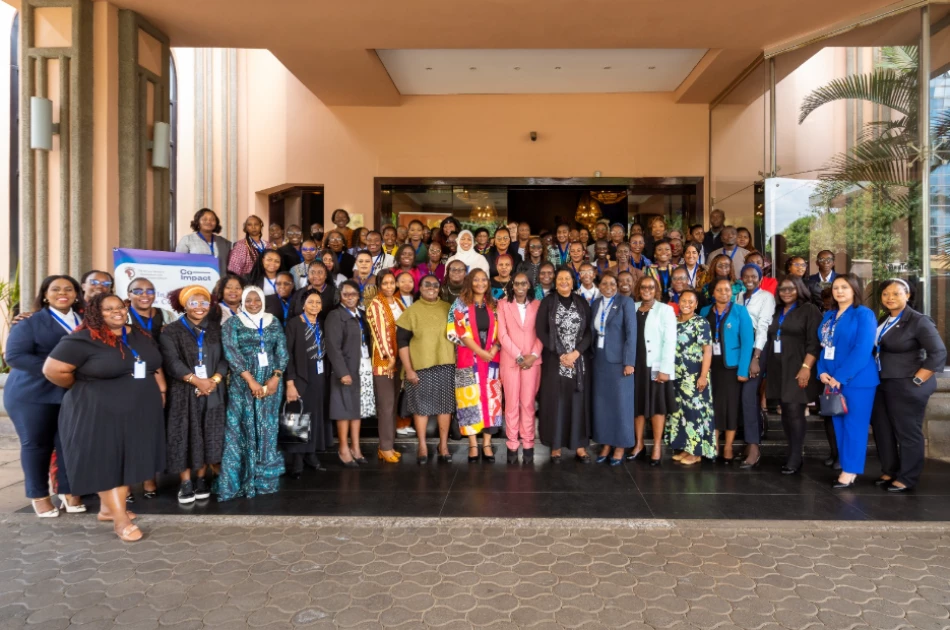
LSK President Faith Odhiambo and Supreme Court Judge Njoki Ndung’u (CENTRE) pose with other attendees of the International Dialogue on Women in Leadership in Law held in Nairobi. PHOTO | COURTESY

Audio By Vocalize
Chief Justice Martha Koome has hailed the gender inclusivity
journey in the country’s justice system evolution.
CJ Koome, Kenya’s first-ever female President of the Supreme Court,
while reflecting on the legal history of the country, noted the milestones made
in recognizing women leadership in the legal system.
The CJ made the remarks in a speech read by Supreme Court Judge
Njoki Ndung’u at the International
Dialogue on Women in Leadership in Law themed: “Women Leading in Shaping
Justice Across Generations.”
Koome holds that Kenya is the African continent’s mirror when
it comes to women in leadership in the justice sector.
“Allow me to begin by reflecting on Kenya’s legal history as
it relates to gender equality and access to justice — a journey that mirrors
the evolution of many legal systems across Africa. It is a story of exclusion
and inclusion, of challenge and transformation,” CJ Koome noted in the speech.
Memory Kachambwa, Executive Director, Feminist Network (FEMNET),
added: “Young leaders are not merely the promise of tomorrow; they are the
driving force of today, actively carrying the mantle of change. It is through
their vision and dedication that progress is forged. Furthermore, we firmly
believe that when women lead, justice prevails. Their unique perspectives and
approaches are essential in shaping a more equitable and just society for all.”
Also gracing the three-day conference was Law Society of Kenya
(LSK) President Faith Odhiambo who said;
“As an advocate who has been in the profession for almost two
decades, I have seen the law operate as both a sword and a shield—a means to
protect rights, and regrettably, at times, a tool to entrench exclusion. I have
seen women rise, but I have also seen them forced to work twice as hard, speak
twice as loud, and climb twice as steep a hill just to be heard—let alone
lead.”
The lawyers’ body boss reminded women in the gathering that they
are a product of many generations of struggle and that behind every woman who
sits on the bench, leads a law firm, drafts a constitution, or lectures in a
law faculty, are women who broke barriers in silence, who challenged unjust systems
without recognition, and who paved the path with pain and purpose.
She added that it is hence important to honor the sacrifices
of those who came ahead by widening the path for those who will come after the
present.
At independence in 1963, Kenya’s legal profession was
overwhelmingly male. Courtrooms and legal offices rarely featured women, and
the idea of a woman judge was almost unimaginable. Yet trailblazers emerged.
In 1967, Effie Owuor became Kenya’s first female State Counsel.
Three years later, she became the first female magistrate, and in 1982, the
first woman judge of the High Court.
Her historic rise culminated in 1998 when she became the first
woman appointed to the Court of Appeal. For years, she was the sole female voice
on the High Court bench — until the early 1990s, when Justices Joyce Aluoch and
Mary Ang’awa joined her.
By 1993, women made up only three of the Judiciary’s judges,
leaving the legal system largely devoid of women’s perspectives.
The tide began to turn with the 2010 Constitution, which
anchored principles of equality and inclusion. Since then, women’s representation
has grown significantly; currently women comprise 42% of judges in superior
courts, 78% of Registrars, and 58% of Magistrates. This is not just progress in
numbers — it signals a more responsive and representative justice system.
Pioneers like Justices Owuor, Aluoch, and Ang’awa laid the
groundwork, as did trailblazing women in legal leadership such as Raychelle
Omamo, the first female Chairperson of the Law Society of Kenya (LSK).
These women rose through the ranks while lifting others,
advocating for justice and inclusion, and nurturing a culture of mentorship.
The Kenya gender equality campaigns has fruits to show in the justice
leadership system, thanks to the efforts that went ahead, according to CJ Koome.
“Women now lead across the sector — including Justice
Philomena Mbete Mwilu as Deputy Chief Justice, Winifridah Mokaya as Chief
Registrar of the Judiciary, Ms. Dorcas Oduor as Kenya’s first female Attorney
General, and Faith Odhiambo as the second female President of the Law Society
of Kenya, a testament of what becomes possible when barriers are dismantled and
merit is given room to flourish,” said the CJ.
The young and veteran women in leadership convention in
Nairobi brought together feminist lawyers, justice sector leaders, and
advocates from across Africa to spotlight and strengthen women’s leadership in
justice space.
Join the Discussion
Share your perspective with the Citizen Digital community.
No comments yet
This discussion is waiting for your voice. Be the first to share your thoughts!