
Gov’t defends fuel levy securitization, says price spike due to global costs
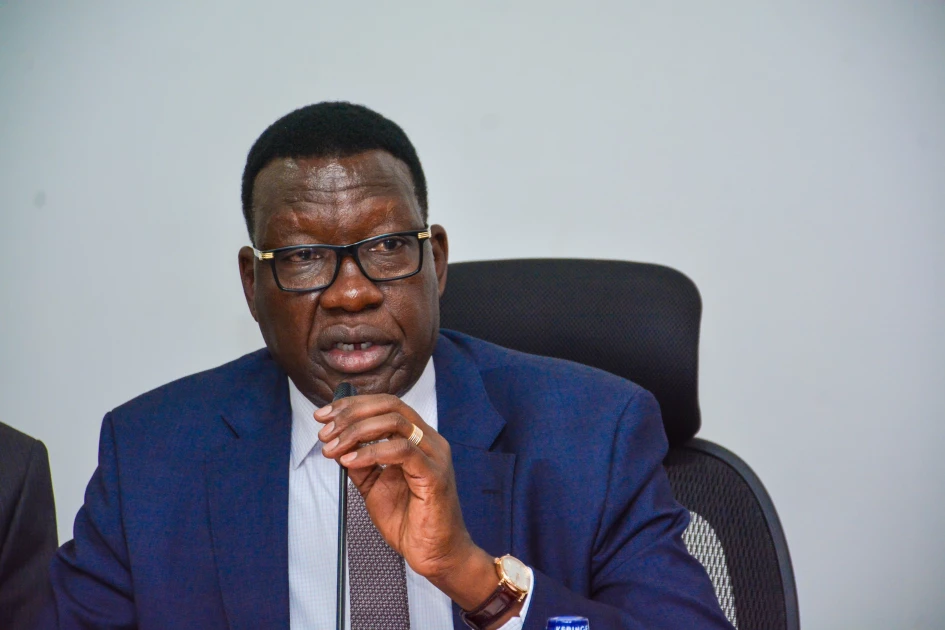
Roads and Transport Cabinet Secretary Davis Chirchir appears before the National Assembly's Departmental Committee on Transport and Infrastructure at Parliament buildings in Nairobi on February 25, 2025. | PHOTO: @davis_chirchir/X

Audio By Vocalize
Roads and Transport Cabinet Secretary Davis
Chirchir on Wednesday defended the government’s decision to securitize part of
the Road Maintenance Levy Fund, saying it is meant to clear some Ksh.175
billion in pending bills owed to road contractors and revive over 580 stalled
road projects across the country.
This is amid public concern over Monday’s
spike in fuel prices, which saw super petrol, diesel, and kerosene costs go up
by Ksh.8.99, Ksh.8.67, and Ksh.9.65 per litre, respectively, from July 15
through August 14.
Securitization in this case is the sale of
the rights by the Kenya Roads Board (KRB) to a Special Purpose Vehicle (SPV), which receives
a portion of the future road maintenance levy, specifically Ksh.7 from the
current Ksh.25 per litre levy.
The SPV, operating as an independent
entity, raises funds upfront based on these rights and uses those funds to
clear the verified pending bills.
Chirchir said the securitization does not
amount to new public debt but is a structured financial arrangement.
“This is not the creation of new debt. It
is the sale of rights to a portion of the existing road maintenance levy to an
SPV, which raises funds upfront to pay contractors,” the CS said.
Kiharu MP Ndindi Nyoro on Tuesday claimed
the government securitized the fuel levy and borrowed some Ksh.175 billion
against it in secret.
But Chirchir argued that President William
Ruto’s administration inherited a large backlog of unpaid bills in the roads
sector from its predecessor, leaving many projects suspended.
Under the arrangement, the Ksh.7 per litre will
be directed towards settling these verified liabilities, without affecting
ongoing road maintenance programs or increasing the government’s debt burden.
The CS maintained that the process was
carried out transparently and with full legal compliance, under the oversight
of the National Treasury and the Attorney General.
“We want to assure the public there is no
secrecy here,” he said.
The Energy Ministry has attributed the rise
in fuel pump prices to higher global fuel costs, distancing the development
from domestic tax adjustments.
Cabinet Secretary Opiyo Wandayi, in a
separate statement on Wednesday, explained that pump price calculations are
guided by the Petroleum (Pricing) Regulations, 2022, factoring in landed costs,
storage, margins, and taxes.
He said international prices for super
petrol, diesel, and kerosene rose by 6.72 percent, 9.33 percent, and 8.15
percent, respectively, between May and June 2025, based on S&P Global
Platts benchmarks.
“In the latest released prices… the [Energy
and Petroleum Regulatory Authority] considered two cargoes of super petrol, two
cargoes of diesel, and one cargo of JetA1 fuel. All these cargoes were
delivered into the country between June 10 and July 9,” Wandayi said.
The Ministry noted that the only domestic
tax change was last year’s July 2024 parliamentary-approved increase in the road
maintenance levy from Ksh.18 to Ksh.25 per litre on petrol and diesel.
Per the recent fuel pricing, the other changes
have been with the rise in the railway development levy (RDL) and import
declaration fee (IDF), which depend on the cost insurance freight (CIF) of the
products.
“It is mischievous and factually incorrect
to link the recent increase in pump prices with the securitization of the road
maintenance levy,” he said, adding that the government has previously cushioned
consumers through price stabilization measures.
On Wednesday, Treasury Cabinet Secretary
John Mbadi explicitly stated that the National Treasury is seeking to
securitize an additional Ksh.5 in the Ksh.18 road maintenance levy, subject to
Parliament’s approval.
Join the Discussion
Share your perspective with the Citizen Digital community.
No comments yet
This discussion is waiting for your voice. Be the first to share your thoughts!