
Electric tuk-tuks signal shift in Kenya’s urban transport
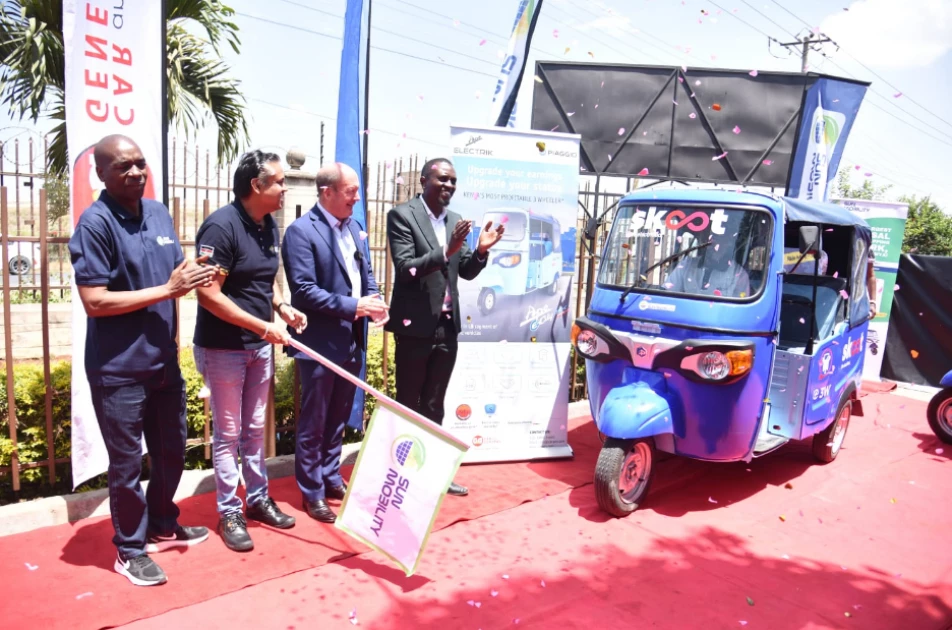
The Skoot e3W, a smart electric three-wheeler introduced by Skoot Technology in partnership with SUN Mobility and distributed by Car & General, is launched in Nairobi. PHOTO | COURTESY

Audio By Vocalize
Electric tuk-tuks are beginning to redefine urban transport in Kenya, cutting operating costs for drivers while introducing cleaner and digitally connected mobility solutions tailored to the country’s demanding road conditions.
This shift is being
underscored by the launch of the Skoot e3W, a smart electric three-wheeler
introduced by Skoot Technology in partnership with SUN Mobility and distributed
by Car & General.
The Skoot e3W combines a
Piaggio-designed vehicle with SUN Mobility’s ultrafast battery swapping
platform, allowing drivers to replace batteries in minutes and avoid downtime
associated with conventional charging.
According to the
companies, a driver covering about 150 kilometres per day can spend roughly Ksh.650
on energy, compared to about Ksh.850 using diesel.
Skoot Chief Executive
Officer and co-founder Sacha Cook said the electric tuk-tuk is designed to help
drivers work more efficiently.
“Skoot is transforming
clean energy and mobility for drivers, homes and businesses. Our unified app
and platform make it simpler to work smarter, cleaner and earn more,” Cook
said.
Drivers use a mobile
application to manage vehicle leases, locate battery swap stations and access
delivery contracts.
The Skoot e3W is offered
on flexible daily, weekly or monthly leases starting from Ksh.1,200 per day,
inclusive of maintenance.
SUN Mobility Co-founder
and CEO–International Ajay Goel said the company’s entry into Kenya builds on
its experience scaling battery swapping solutions elsewhere.
“Our universal battery
swapping solutions are built for hard-working two- and three-wheeler drivers
everywhere, who depend on us to make their living. After significant success
and scale-up in India, we are thrilled to be launching in Kenya with Skoot,”
Goel said.
Car & General General
Manager George Rubiri said the partnership is aimed at supporting reliable
daily earnings for drivers.
“With our distribution and
servicing footprint and Skoot’s digital tools, we’re confident this product
will transform how drivers work,” Rubiri said.
The companies said trials
conducted over the past 24 months in Nairobi tested performance under load,
maintenance demands and rider experience, resulting in an electric tuk-tuk adapted
to local traffic and road conditions.
Benson K., a driver
involved in the pilot, said the electric tuk-tuk has simplified his daily
operations.
“I don’t waste time and
swap in minutes to get back on the road. My earnings are more stable, and the
app makes everything easier – charging, payments and support,” he said.
As battery swapping
networks expand and more electric three-wheelers enter the market, electric
tuk-tuks are emerging as a practical and cost-effective alternative for Kenya’s
fast-growing last-mile transport sector.
Join the Discussion
Share your perspective with the Citizen Digital community.
No comments yet
This discussion is waiting for your voice. Be the first to share your thoughts!