
BRT: An ambitious transport system or just faded red lines on Thika Superhighway?
A model for the BRT system on the Thika Superhighway.

Audio By Vocalize
Well, Sakaja’s declaration awakened a record of pledges that most Kenyans have heard again and again. Let us call it a BRT riddle. A project whose implementation has long remained an ambitious but floating plan, always assured but never executed.
In a courtesy call, Sakaja, South Korea Ambassador to Kenya, Kang Hyung-Shik, affirmed his country’s commitment to the construction of Line 5 of the Nairobi BRT that will link the City Centre to Jomo Kenyatta International Airport (JKIA).
Thika Highway markings that gave many hope
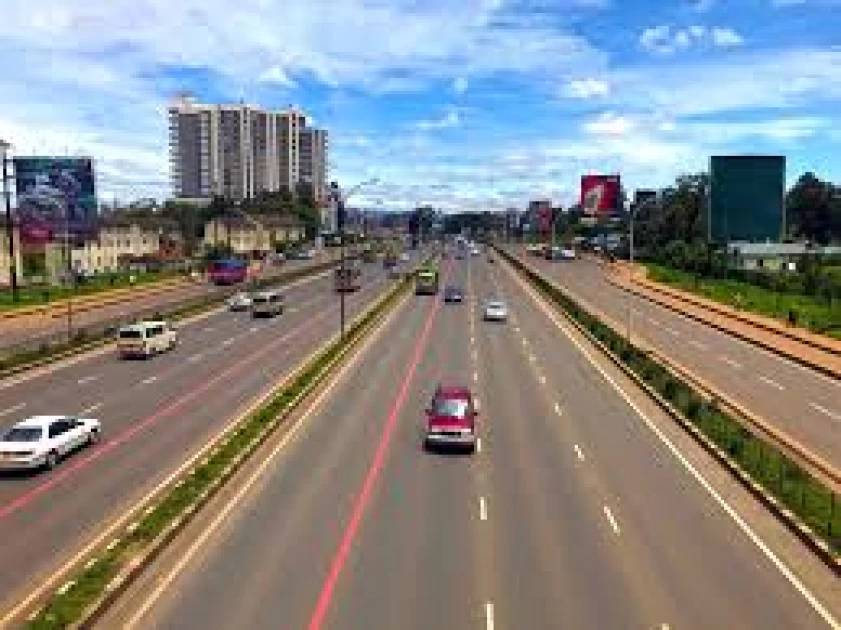
Red markings made on the Thika Superhighway in 2018 caused a buzz in the ‘city under the sun’. Dubbed the ‘Pink Lipstick’, the newly-painted BRT lanes sparked light humor online, with citizens saying it was the closest Kenya came to actualizing the BRT system.
In April 2018, government officials explained that the pink road markings on the Thika Superhighway were dedicated road lanes on the super-highway to be used by BRT designated high-capacity buses with a capacity for over 80 passengers, travelling non-stop from outlying estates to the Central Business District (CBD).
The government authorities also said that the buses were to be operated by the National Youth Service (NYS).
Then Transport Cabinet Secretary, James Macharia, explained, “because we require more than 900 buses for (the full BRT system), which we do not have right now, we shall start with one corridor, the Thika Highway coming into the city."
"So that with the few buses, although they are not fully BRT compliant because these are normal National Youth Service (NYS) buses, we can start having those dedicated buses to bring commuters into the CBD," added Macharia.
Not even this under-representation bore fruit as the “pink-lipstick” markings, done more than seven years ago, have now faded as more promises on the same are made to the weary daily commuters in Nairobi.
What is Bus Rapid Transit (BRT)?
The “BRT” is a modern public passenger transport system designed to improve capacity and reliability in congested cities.
It is based on dedicated road lanes that must not be used by vehicles other than large buses operated by BRT companies.
Normally, operating a successful BRT involves building new roads, interchanges, terminals and modern stations along the routes. Cities world over, Nairobi included, are encouraged to adopt BRT by public urban planners to ensure sustainability, the dignity of passengers and reliability in mass passenger transport.
It is believed that the BRT is the solution to congestion, as it increases effi¬ciency in mass motorized movement, and ultimately reduces air pollution.
Proposed BRT outlay Nairobi
There are five BRT lines proposed in Nairobi. The first one is the Ndovu line, which runs from Kangemi, off Waiyaki Way, to Imara Daima off Mombasa Road. The second line, named Simba, emanates from the Bomas of Kenya area to Ruiru, off Thika Highway.
The third line, named Chui, kicks off at Njiru and then moves all the way to the Show Grounds near Jamhuru Estate off Ngong road. The fourth line is christened Kifaru. This line starts off at Mama Lucy hospital area and then moves all the way to T-Mall on Langata road.
The fifth BRT line, Nyati, starts off at Balozi in South B and then moves onto Mombasa Road and all the way to Imara Daima.
Spear-headed by the government, the BRT system is the hope of many Kenyans that once complete, it will reduce traffic congestion along major routes such as Mombasa Road, Thika road, Langata road, Jogoo road and Waiyaki Way just to mention a few, it will lower daily transport costs, and create jobs during both its construction and operation, it will also boost tourism through easier airport access.
Kenya’s BRT history has been full of empty rhetoric
In October 2018, President Uhuru Kenyatta announced that at least two stages of BRT must be ready for him to ride by December 12, 2018. In his words, “we need a dedicated right of way for the buses, not just paint.”
A few weeks later, the local press was awash with reports that the BRT had stalled yet again owing to a lack of money to buy high-capacity buses and build supporting BRT infrastructure. It was another illusion.
The claim in 2018 by CS Transport James Macharia and City Hall officials that the government was planning to import 100 high-capacity buses, yet there was no budgetary allocation, was the tale behind the failure.
Poor systemic policies have seen the government fail to lure solid potential investors into the multi-billion-dollar project.
In February 2022, the government again assured Kenyans that it would roll out the first BRT by June of the same year. The 2022 Nairobi Metropolitan Area Transport Authority (NAMATA) acting Director General, Francis Gitau, said that BRT buses would be deployed on Nairobi’s Ksh.88 billion elevated road linking Jomo Kenyatta International Airport (JKIA) to the Nairobi-Nakuru highway in Westlands. All these promises slipped under with no explanation.
Legal and regulatory framework for BRT
A World Bank report in August 2022 said the absence of an enabling legal and regulatory framework and ineffective coordination with existing public transport operators was undermining the commercial viability of the BRT project.
The multilateral lender report pointed out that key reforms within the transport sector must be undertaken by the state for the BRT system to work. These included policy reforms as well as whipping political will into place to set the BRT project rolling.
Kenya was advised to prop up its institutional capacity, which should be tasked to oversee the budget, planning, construction, and operations of BRT systems.
The World Bank advised Kenyan authorities to come up with a balanced collaborative participation model for risk allocation and benefit-sharing among public and private stakeholders.
Failure to, the multi-lateral lender warned that private sector participation would be low, and this would weaken the price discovery effect of the Public-Private-Partnership (PPP) model and exacerbate rent-seeking and contract breach risks due to ineffective competition among qualified private participants.
Back in 2022, the Institute of Transportation and Development Policy (ITDP) estimated that Kenya required around Ksh.100 billion to implement BRT system to ease Nairobi’s ever-worsening traffic congestion in Nairobi.
Failed attempts to set BRT network
Since Kenyatta’s time in office, Kenya has been seeking investors to set up a multi-billion shilling Bus Rapid Transit (BRT) system in Nairobi to alleviate traffic congestion, with each passing year touted as the start line.
The Five-Line BRT project has nonetheless received support and cash injections from the EU, Korea, and Kenya over the years. The BRT approach is desirable because it is environmentally friendly, and hopefully, a cashless system that is hoped to transform public transport.
Right from the Jubilee government regime, some of the key details regarding the BRT project include having the BRT moving over half a million people daily into and across the city of Nairobi.
This will greatly reduce traffic congestion and also result in lower carbon emissions as compared to the current scenario.
In terms of infrastructure, the BRT will incorporate dedicated lines, a good number of stations and ramps, and extensive pedestrian walkways.
While the project was initiated under President Kenyatta and has stalled to date, subsequent efforts have focused on fast-tracking specific lines to address urban mobility.
BRT funding in the last 10 years
On or around October 12, 2021, the Government of Kenya borrowed KSh6.4 billion from the Korean government to finance the Bus Rapid Transport (BRT).
The loan from the Korean Export and Import Bank will be serviced by taxpayers until January 29, 2061 with an annual interest rate of 0.1 per cent per annum.
In 2024, the government also secured a Ksh.7.6 billion loan from the Korean Export-Import Bank to kick-start the construction of the Line 5 corridor, with the Kenya Urban Roads Authority, KURA, inviting tenders for its commencement.
On September 30, 2023, President William Ruto signed a Ksh.8.7 billion deal with the US foreign aid agency MCC for the acquisition of electric buses, which will operate on Line 2 of the BRT. The deal was signed on the sidelines of the 2022 United Nations General Assembly (UNGA) in New York.
What ails Kenya’s BRT implementation?
When properly designed and implemented, BRT systems can move upwards of 20,000 passengers in each direction each hour, which by far outpaces passenger vehicles at any time.
In huge cities like Jakarta in Indonesia, Curitiba in Brazil, Mexico City in Mexico, Guangzhou in China, Amman in Jordan and Peshawar in Pakistani to mention but a few, the utilization of the BRT system has been greeted by huge success and enormous savings of time, the environment and money.
However, in Kenya, the biggest problem remains the lack of political will to actualize the BRT blueprints Kenya has to implement them in Nairobi and its environs.
Curving out Bus-Only lanes from existing three or two lanes, the State fears would result in a public backlash and negative online sentiments that they would rather not handle.
This, coupled with resistance from the unruly matatu sector who think that the BRT system would ruin their businesses and yet it employs so many, especially among the youth, who might paralyze public transport, sends down jitters down the spine of most state operatives.
What are the solutions towards getting a functional BRT system in place?
The policymakers in Kenya need to appreciate that growth calls for sustainability. Growth demands for planning and the BRT system are the panacea for the choking traffic on Nairobi roads each day.
Kenya should opt to pilot BRT corridors that prioritize people and measure viable results that could be replicated in subsequent projects as they scale up.
Ultimately, the policy-makers should ensure the resultant infrastructure is beneficial not only to the investors but to the commuting public in terms of dignity, efficiency and cost effectiveness.
Piloting the BRT system would be in Kenya’s best interests, as transformation is a journey and not a race. It happens lane after lane, line after line, investor after investor, in borough after borough, and partnership after partnership.
In BRT systems, Kenya has the chance to create systems that are safe, inclusive, and sustainable by ensuring every shilling invested in transport translates into safer public transport, a cleaner environment, and accessibility for all citizens.
Let Kenya push for mobility that puts people first and ensures their dignity. Because Kenya’s future depends on how we move and how boldly we choose to change direction.
Each minute we save while commuting is transferable to family, to work, to leisure and learning among competing priorities to achieve a balance in life.
True transformation in Kenya’s public transport sector entails more than extra lanes and good buses; it calls for leadership, political courage, and collaborative vision, leaving no one behind.
As the government now shifts to higher gears to get to Singapore. It must not relent in ensuring it has the means to carry its people to Singapore; it will need these same people in Singapore to make the economy thrive.
Join the Discussion
Share your perspective with the Citizen Digital community.
No comments yet
This discussion is waiting for your voice. Be the first to share your thoughts!