
Djokovic's father courts controversy again
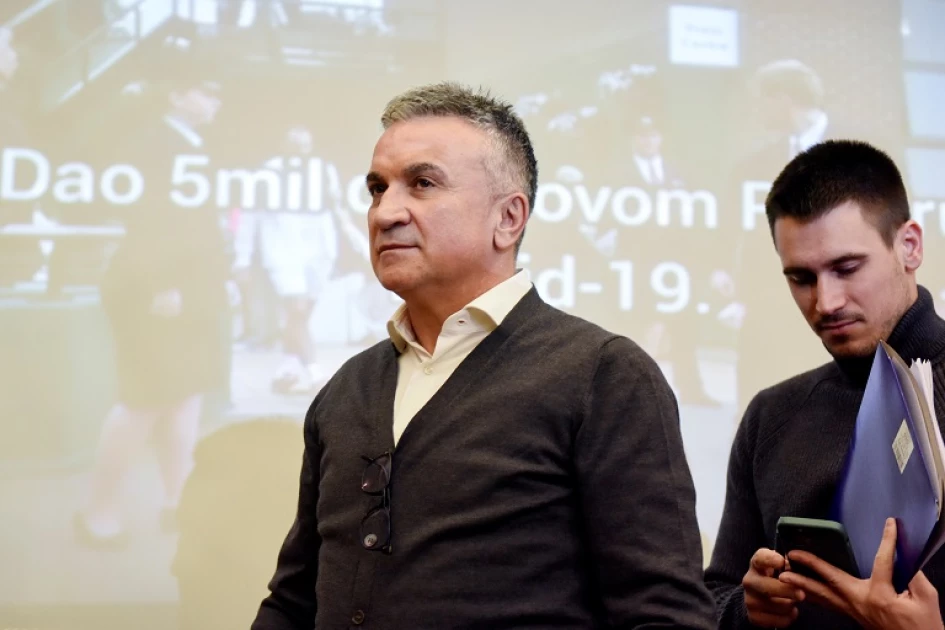
Serbian tennis player Novak Djokovic's father Srdjan and brother Djordje attend a news conference in Belgrade, Serbia, January 10, 2022. REUTERS/Zorana Jevtic

Audio By Vocalize
Brash, loud,
and combative, Novak Djokovic's father Srdjan has again stolen the spotlight
from his son in the latest off-court controversy to rock the tennis star's
career.
This week,
Srdjan made headlines again at the Australian Open after the 61-year-old was
filmed posing with fans brandishing banned Russian flags, including one
featuring Vladimir Putin, in scenes Ukraine's ambassador Thursday slammed as
"a disgrace".
Since the
invasion of Ukraine, many in Serbia have actively thrown their support behind
Moscow, with pro-Russia murals appearing in Belgrade, ultranationalist football
hooligans rallying behind the Kremlin's cause, and demonstrators in support of
the war taking to the streets.
The
controversy in Melbourne came as Djokovic had just booked his place in the
semi-finals with a straight-sets thumping of Russian opponent Andrey Rublev at
Rod Laver Arena on Wednesday.
But for
Srdjan, making waves was nothing new.
Last year,
Srdjan took a leading role in defending his son after he was detained and later
deported from Australia over his Covid-19 vaccine status.
In the
Serbian capital Belgrade, he led boisterous protests filled with flag-waving
demonstrators and held his own heated press conferences where he compared
Djokovic's plight to that of Jesus Christ.
"They
try to crucify Novak too, to humiliate him... He will endure," Srdjan told
reporters at the time.
Over the
years, Srdjan has stuck to a familiar script, framing the occasional
controversy involving Djokovic as an ongoing battle between an ambitious Serb
on the international stage and a jealous West.
"The
West doesn't like him," Srdjan told Prva TV in 2021.
"They
will have to accept that he is the best, and will be the best in tennis
history."
Born in a
small mining village in impoverished Kosovo, Srdjan moved to Belgrade as a
teenager where he pursued a career as a skiing instructor before meeting his
wife and starting a family.
Novak was
their firstborn and showed early promise in sport, especially tennis.
"We sat
with him on a table when he was 10 years old and asked him -- what do you want
to be when you grow up? He said he wanted to become the tennis number one,
which we completely supported and I dedicated myself to his career,"
Srdjan told Serbian newspaper Kurir.
But raising
a tennis champion proved expensive, especially during the war years in Serbia,
when the country was hit with sanctions amid the bloody break-up of Yugoslavia.
Srdjan has
said he sold the family's gold for cut-rate prices and even borrowed money from
a loan shark to finance his son's early career.
But along
with the sacrifices, Srdjan also exhibited a heavy-hand in controlling his
son's career -- on and off the court.
"Since
he was six, we look after every aspect of his career. What he would work on
today, tomorrow, a month or year from now. What he eats. What he drinks,"
Srdjan said.
"Every
aspect and detail of his life is under control."
Srdjan has
even admitted to neglecting his other children in the quest to nurture Novak's
future and described himself as a "mother, father, coach, physician --
everything".
"Only
Novak mattered," he told Serbian media.
"All of
us... were irrelevant. Everything was done so he could achieve what he
did."
Join the Discussion
Share your perspective with the Citizen Digital community.
No comments yet
This discussion is waiting for your voice. Be the first to share your thoughts!